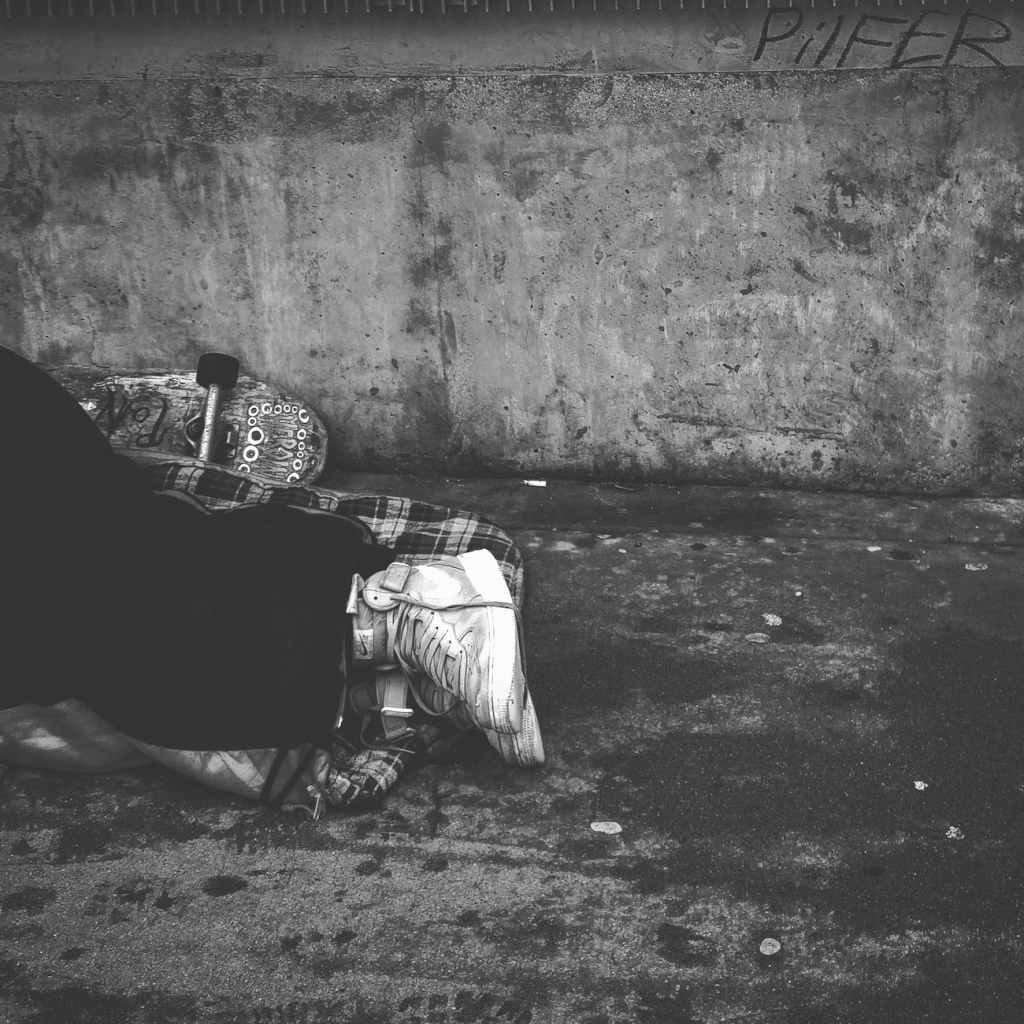
I recently moved to a place where poverty is a very public problem. It was a problem where I lived before, but it wasn’t as obvious, at least not until the tent cities started popping up under all of the freeway overpasses in town. This was happening all over the country, as the inevitable result of unchecked capitalism created thousands if not millions of homeless people, many of them children.
Being homeless where I used to live was a harsh proposition given the hot weather. It’s more pleasant where I live now, and the state and local government’s policies towards the homeless are more merciful and giving, so there seem to be more of them because they’re naturally drawn to more forgiving areas. I know I would be if I were in their shoes.
As such, wherever I go, I see them. The issue is unignorable and right up in my face, and being the philosophical person that I am, it made me think about it. A lot. And I discovered that in thinking about the plight of the homeless and the impoverished, I was forced to think about many of my own attitudes regarding finances and materialism as they applied to my own life.
I was embarrassed to find that I had a lot of entitled attitudes regarding what I have and what I think I’m supposed to have. I was also embarrassed to find that I wasn’t very grateful for what I had, and that was feeding a need for “more”. I immediately tried to instill more of a sense of gratitude into my life for the little things and for things that are often taken for granted, like indoor plumbing. After some time, rather than viewing my life through a lens of what I didn’t have, I began to see my life for what I did have, which I realized was a great deal.
With that came more embarrassment and shame at having ever been so greedy and entitled in the first place, especially when there are so many people who would give anything to have what I have, and I feel I live fairly modestly. I don’t live in a big house: it’s rather small actually, only about 1100 sq. ft. But that would be palatial to someone who has been living in a leaky tent on the cold streets, and I began to see my life through that lens. I don’t buy a lot of expensive foods, but what I do buy is nutritious, tasty, and far more than what people on the street have access to. It makes me grateful for something as simple as tuna noodle casserole even though my favorite foods are more expensive fare.
When I do allow myself to have more expensive things, I enjoy them all the more now. I used to inhale my food without really tasting it, as many of us do, mostly because we’re so busy. Now I see mealtime, especially a special one, as a respite from the fast pace of the world, a time to suspend myself from all that and really savor what’s in front of me, feel how my body reacts to it as I eat it. To really experience my food and therefore appreciate it. It’s a time to be grateful I even have food to eat, because a lot of people where I live don’t.
In the midst of these more personal musings, I began to think in a larger context that included the economic injustice and disparity in our society and in the world at large. It suddenly made a little more sense to me how it was that there are so many people in the world who can look at poverty and have pretty much the opposite experience that I did. It’s a matter of psychological uncomfortability and cognitive dissonance. The amount of shame and embarrassment that someone of great means must feel upon being faced with poverty must be overwhelming, to the extent that they are forced to make one of two choices: use their means to do something about it in an effort to assuage their guilt, or ignore it, which is what most super-rich people do.
The only way to truly ignore suffering on this level, particularly when a person is directly responsible for it, is to moralize their way out of what is otherwise a position of evil. They have to tell themselves that the suffering person or persons deserve their suffering, that they brought it upon themselves, and that they are not worthy of assistance. This has the effect of allowing or even enabling great suffering on a massive scale, all under the aegis of moral righteousness. It also enables a sense of superiority on the part of the entities responsible for inducing the suffering.
This is what morality without ethics looks like. Morality is supposed to be the set of guidelines that an individual lives by, while ethics are supposed to be what’s good for the collective, generally speaking. Part of our problem in America right now is the grotesque disparity between the individual morality that one group of people is attempting to impose, and the rest of us, who are attempting to establish better group ethics for all of us.
I see this divide between morality and ethics constantly in the comments to posts concerning the homeless problem in my area. They’re a very predictable mix between people who think the homeless are lazy vermin who brought their fate upon themselves and deserve absolutely no assistance unless it’s into a jail cell, and people who recognize the circumstances that drove those people to the streets and that it’s only by addressing the source issues will the problem itself be addressed. The morality crowd is too hung up on the ‘worthiness’ of the homeless, though. They’re too busy judging them to care about how they got there, and if they did know, they’d probably find a way to judge that too.
That is the fundamental difference between the two different camps in our country now: the side that uses their personal morality to issue judgment and condemnation upon the rest of us, and the side that uses collective ethics to create a better world with more equanimity and actual freedom, not the strange, very restrictive “freedom” proposed by the more ‘moral’ crowd. The only things progressivism ‘restricts’ are those behaviors and actions that repress another individual’s freedom to express their truth, as long as it doesn’t hurt anyone. That last bit seems to be the sticking point. The morality crowd has no problem hurting someone in the name of enforcing their morality, while that is the antithesis of the ethics crowd’s way of thinking. We do not impose suffering in the name of morality, period.
I myself am not responsible for inducing suffering to these people, but my compassion drives me to help in whatever way I can. My husband and I volunteer at the local food bank at least once a month to help bag up uneaten food that gets donated from various places around the city. We could do more, though. The sight of people living in the cold and the wet spurs me to think about what else I could do to help, within the boundaries of my own limitations. Our own budget is fairly tight, which means we can only do so much. We are amongst the tens of millions of middle-class Americans who make what should be a decent income but still struggle from paycheck to paycheck, and we do not live extravagantly.
The real issue, of course, is getting the people with the means to help to actually do so, and I’m not sure how to make that happen. I don’t know how to convince people who are themselves convinced that the other 8 billion of us aren’t worthy of leading comfortable, secure lives that they should change their minds. They have removed themselves so far from having to see the results of their actions that it is impossible for them to be impacted by them, and they’ve done that on purpose in an effort to avoid the crushing guilt, shame, and embarrassment that has to come to any decent human being who realizes they’re responsible for suffering on such a massive scale (which begs the questioning of these people’s decency). Meanwhile, the people who support them are themselves caught up in the morality game of judging suffering people as well as in the illusion that they’ll be one of the chosen ones if they just keep playing the game they’ve been taught to play.
It makes me angry that my husband and I, with our fairly modest lifestyle, should feel guilty about the homeless on the street and make ourselves anxious with what we can do to help them when we’re not the ones with the resources to do anything about it. People with far more money than us are, and they’re not doing anything because of morality-driven greed. In the meantime, people on the street are starving and good-hearted people such as my husband and myself are forced to watch, relatively powerless to stop it. The help we can provide is nothing compared to what’s truly needed.
However, the personal lessons and attitude shifts that I have experienced since beginning to seriously contemplate this issue have been quite positive and I wouldn’t give them up. I really felt my privilege, and instead of turning away from those feelings, I faced up to them and changed my attitudes and actions so that I would feel better and be better. I feel strongly that in these troubled times, it is the little shifts in energy that are going to make the difference in turning the tide, so it’s important to lead by example. Even a small rock makes ripples in the pond, and one person tossing their rock into the pond encourages others to do so. I may just be one person packing food at the local food bank every now and then, but it makes a difference, even if it’s just a small one. People working together with small differences ultimately make big differences.



 The Bipolar Bodhisattva
Leave a comment