
I’ve been a student of Zen Buddhism for some time now. I’ve read a wide variety of books offering numerous perspectives on the simultaneously simple-yet-complex philosophy of Zen. Views range widely from harsh teachings-by-the-stick to more gentle deliverance of lessons. As a trauma survivor, I’ve had quite enough of harshness in my life, so I tend to veer towards the more gentle approaches to Zen, such as those presented by the late Thich Nhat Hanh. Even in written transcripts, the compassion with which he exercised his practice comes through clearly, and there is zero sense of ego in his presentations and teachings.
This has become a benchmark by which I measure all Zen (and other) teachings, regardless of where or who they come from or how old they are. While I’m reading or listening, do I feel as though I am being caringly professed to by a compassionate teacher, or do I feel as though I am constantly being beaten with a stick and told that I am wrong? It doesn’t matter if it’s true that I am wrong, all I’m going to remember is that I was beaten with a stick.
So it was with some delight when my church’s spiritual book discussion club chose Nothing Special by Charlotte Joko Beck, who practiced a unique flavor of Zen that tries to blend its Eastern roots with Western sensibilities. She didn’t shave her head or wear robes, and tried to embody the wisdom that there is “nothing special” about the successful practice of Zen. It sounded very refreshing and I looked forward to reading the book.
At first I was encouraged as I read the opening words describing one’s life as a whirlpool in a river. I thought it was a lovely and apt metaphor: we are always one with the river of life, it is only when the river spins into a whirlpool that we become aware of that momentary difference between spinning and flowing. The magic of Zen is in realizing that we never stop flowing, even as we spin. Then life becomes a dance of joy, and we need not fear rejoining the river, because we never left it.
I was similarly charmed by the imagery in the second chapter about The Cocoon of Pain. I might not have understood this chapter properly were I not currently doing a lot of pain and grief work therapeutically speaking. I now understand the wisdom of rather than avoiding one’s pain, of surrendering to it, of allowing it to surround you. It is only in our constant quest to escape pain that we paradoxically find ourselves drowning in it. Conversely, by surrendering to our pain, we paradoxically find comfort because we’re allowing our pain to convey its lessons and thereby heal and be healed.
It might not be something that can be understood unless it has been directly experienced, as I recently have, and so I keep that in mind as I speak of the next chapter, which was where I heard a loud record needle scratching in my mind, disrupting the otherwise pleasant music of the lessons I was reading. This chapter used the Greek myth of Sisyphus to try to make a point about accepting life’s burdens, a philosophy within which there is wisdom, but is grotesquely open to abuse.
Acceptance is a concept within Buddhism that I have always had a great deal of trouble with, particularly as a trauma survivor. Buddhism, when taken to its purest philosophical extreme, says that my physical existence is merely an illusion and so that anything that happens to that physical existence is also illusion. If I am experiencing suffering, it is only because I do not realize the reality of that illusion. This is the ‘absolutist’ position of Buddhist philosophy.
Frankly, I find this to be an abuse of the philosophical concept of the illusory nature of reality within Buddhism. An abuse that can far too easily be used to justify real life abuses against other human beings in the name of spiritual sanctity. Joko, as she called herself at her school of Zen in San Diego, is quoted as saying at the end of the chapter about Sisyphus, “Sisyphus was not a prisoner in Hades, living out eternal punishment. He was already free, because he was just doing what he was doing.”
Translation: if Sisyphus was enduring suffering because of his punishment, it was because he had an attitude problem. If he had simply accepted his fate and lived in the moment of pushing the boulder, he would have found freedom.
As I read the quote from the book, I instantly remembered a figure from 1990s Texas politics: Clayton Williams. Mr. Williams gained public notoriety in the Texas gubernatorial race against Ann Richards, a race he was winning until he opened his mouth in front of some reporters around a campfire on his land one weekend. He was on record as saying, “If it’s inevitable, just relax and enjoy it,” in regards to rape, likening it to “bad weather”.
He later said he was just joking, like all good ol’ boys do, but the damage had been done and he lost the race to Ms. Richards (Goddess rest her silver-haired soul). I thought about his comment in the context of modern day politics, when a man who was caught on camera saying “grab ‘em by the pussy” actually won the American Presidency over a woman, and was sad about how far our country has fallen.
For an American woman to have presented as peaceful a philosophy as Zen Buddhism in such a way is simply unconscionable. Perhaps she had the proper wisdom but simply lacked the words to convey it, because this is not the message to be sending people in a culture that has as much of a problem with consent and judgment as ours does.
Perhaps this is also illustrative of how grossly Eastern and Western philosophies and sensibilities clash. Even Carl Jung actually recommended against Westerners pursuing an Eastern philosophical path because of the inevitable and extreme cognitive dissonance they would come up against in their quest for enlightenment. While there are places where East and West overlap and have commonality, in other areas they are so widely disparate as to be completely alien to one another.
One of these areas has to do with ego. The West is so incredibly steeped in ego-based thinking that it is virtually impossible for someone to truly break it down in the same way an Easterner can. We simply don’t think the same way. Some cultures in the East do not have a concept of “I”, which is unthinkable to most Westerners. It makes us go, “what??” Even in the East, the human psychology is prone to falling into ego traps. They can be seen in the stories about Zen teachers who are harsh and punitive to anyone who does not follow what they view to be “the right way”. Whose verbal retorts to their students’ queries and ideas inevitably boil down to “you’re wrong and stupid for being so”. Who teach by the stick rather than by the heart.
As I read Joko’s book, I felt like I was being taught by the stick, not by the heart. The book is presented as both essays and as transcripts of talks between herself and her students, and in both instances I felt as though I were being lectured to in the manner of a stern Western university professor, one very full of themselves. She spoke of having to “tighten up the teachings” to keep everyone on track as her school grew, and I again saw the stick in my mind.
This was not the gentle, compassionate Zen of Thich Nhat Hanh I had come to know and love. His books would leave me filled with a sensation of warmth and fullness, as though I had eaten a very satisfying and nutritious meal. This left me feeling as though I had eaten a school lunch prepared by prison cooks.
I stopped reading and talked with my husband about my feelings about the book a bit, and he looked her up on Wikipedia to discover that not only had she passed away in 2011, she was born in 1917. Suddenly her perspective on not only Zen but specifically as a Westerner was made clear to me. Her generation was one that venerated authority but that was also willing to forge new social paths, which is probably what drew her to Zen in the first place. Zen was introduced to the United States in the early 20th century by fairly authoritarian, patriarchal Asian men, which inevitably flavored the teachings they brought to our shores, and therefore, to her.
At first I put the book down, not intending to finish it. I almost never do this. Rarely do I not finish a book that I have begun. I just couldn’t get over the mental sound of that needle scratching on the record as I read her evaluation of Sisyphus and how he should handle his reality, though. Every philosophical and spiritual system has a failing, and how Buddhism handles the subject of acceptance is potentially one of its failings, depending on what flavor of Buddhism you’re talking about.
However, I didn’t want to throw the baby out with the bath water, so to speak. So I continued reading at the encouragement of a fellow reader who insisted my objections were addressed further on in the book when Joko talks about the difference between absolutism and relativism. She criticizes the violent ethic of the samurai as being a misapplication of absolutist philosophy in the relativistic context of actual life, which I wholeheartedly agree with.
So it was with considerable consternation that I encountered another section of the book in which she claimed that it is impossible for one to be truly harmed by another because of the inherently unified nature of existence. I found this itself to be a misapplication of absolutist philosophy, again from my admittedly biased perspective as a trauma survivor. As a fairly advanced student of Buddhism, I understood what she was trying to say, but she handled it very clumsily, imprecisely, and inaccurately.
What she did not make clear was the distinction between pain and suffering. Pain in life is inevitable and unavoidable, while suffering is not. Avoiding suffering is what Buddhism tries to teach, not the avoidance of pain, which is impossible. The word ‘pain’ itself can be interpreted to mean everything from mild psychological dissatisfaction to excruciating physical discomfort. If we can recognize that our pain is unavoidable and stop fighting against it, its intensity actually eases or even abates entirely, especially if it’s something temporary and we can recognize it as such.
It is true and wise that, to a certain extent, we should accept what happens to us in our lives because we are all subject to events that will cause us to experience pain. Various forms of loss, death, and change are inevitable in life, and I know that how to deal with the waves of life with as little suffering as possible are what Buddhism tries to teach us about. However, when professing acceptance veers into potentially preaching learned helplessness in the face of oppression, I cannot support that.
I seriously doubt that’s what Joko meant when she wrote her words. But as Takeshi Kovacs says in Altered Carbon, “when everyone lies, telling the truth isn’t just rebellion, it’s an act of revolution. So think carefully when you speak it, because the truth is a weapon.”
Clearly it is too late for Ms. Beck to hear this lesson, and I do not mean to impugn anyone who gained wisdom from her teachings. However, these are volatile times that we live in, times in which people are in great need of teachers speaking the truth of more peaceful philosophies such as Zen. Which means that those who put themselves forth as teachers of such philosophies must be very careful about what they say and how they say it. They must think about the different contexts in which their words can be taken so that they do not inadvertently do more damage in an already fragile world. They must remember that above everything else the human race needs right now, we need to be taught by the heart, not by the stick.
We can walk our road together
If our goals are all the same
We can run alone and free
If we pursue a different aim
Let the truth of Love be lighted
Let the love of truth shine clear
Sensibility
Armed with sense and liberty
With the Heart and Mind united
In a single perfect sphere
Rush – Hemispheres: Cygnus X-1 Book 2
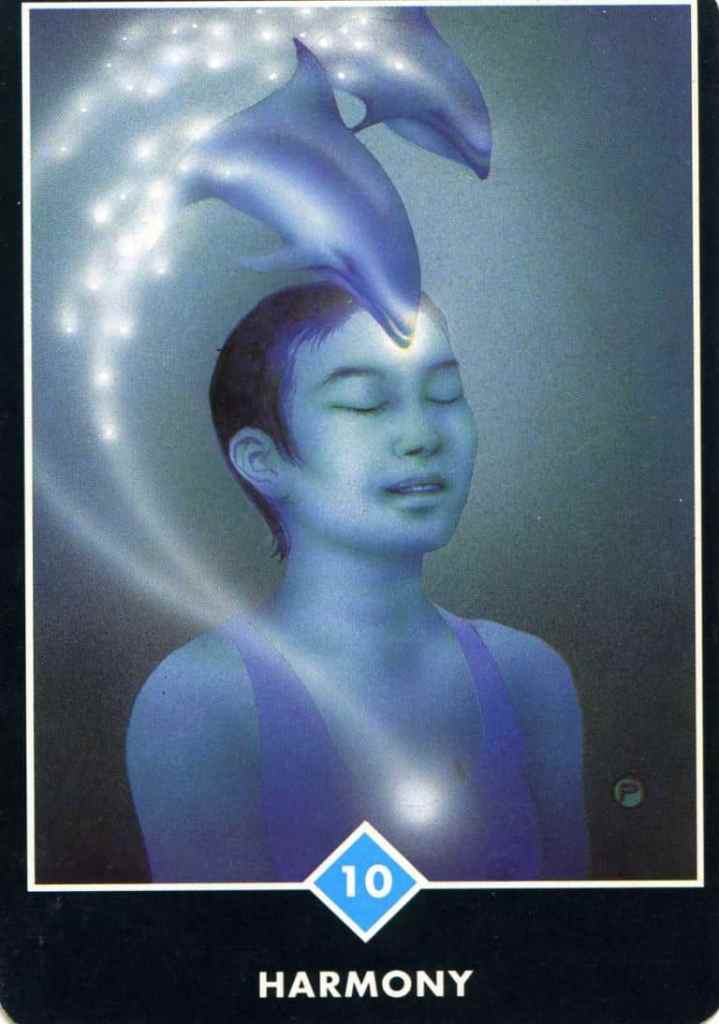
Ten of Water from Osho Zen Tarot




 The Bipolar Bodhisattva
Leave a comment