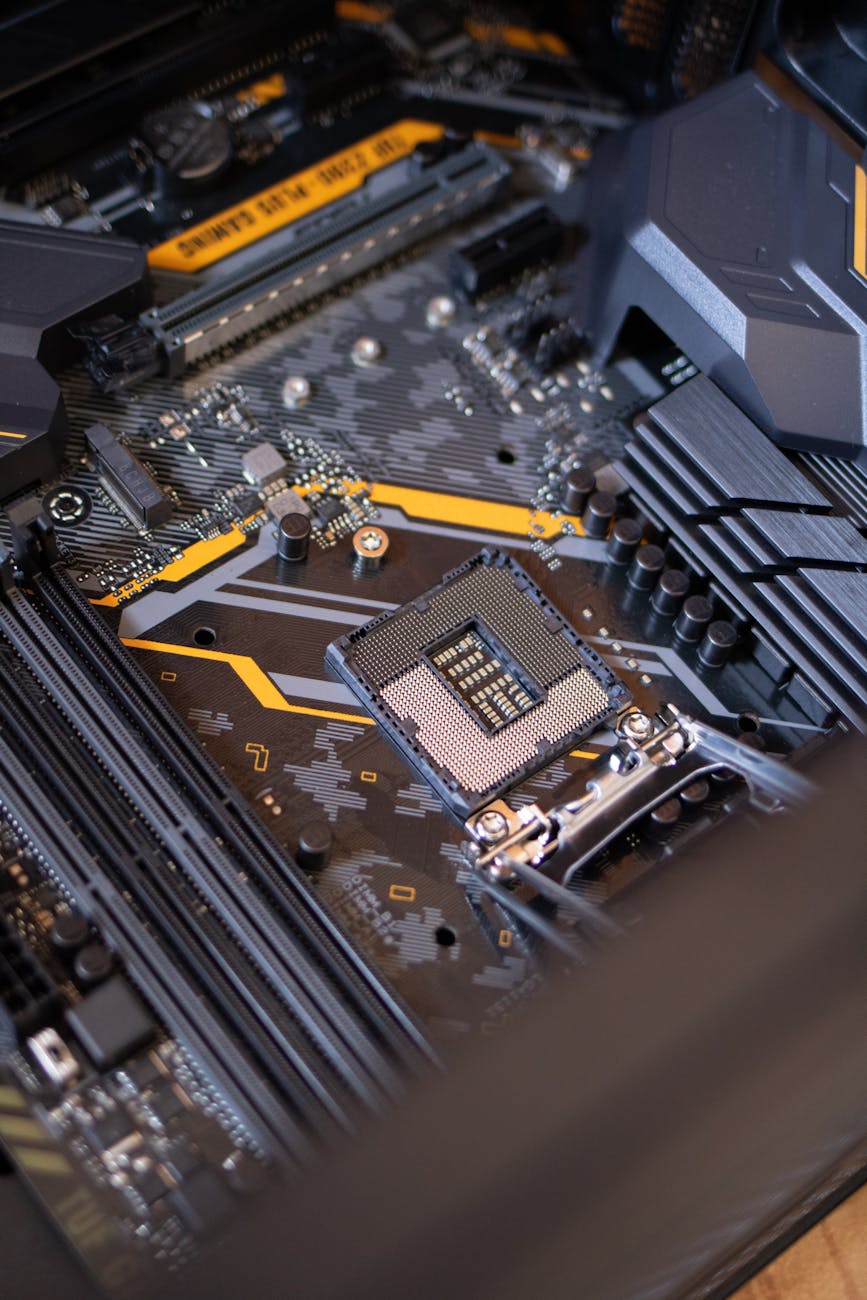
Ever since my awakening and individuation process kicked off several years ago, I have often found it useful to equate my mental processes to that of the varying parts of a computer system. It’s quite easy to make analogous parallels between how a human mind and even body operate as compared to how a computer operates. There are limitations as to how far the analogies can be carried, but they’re still useful.
For instance, early on in my process, it felt like the rewiring of my neural pathways to something healthier was a bit like overwriting a bad sector on a hard drive. I could feel it in my brain as the electrical impulses of the old, bad way of thinking attempted to fire, only to be disrupted and diverted again and again by my conscious efforts to engage in a new and better way of thinking. It reminded me of the sound of the reading head of a disk-style hard drive repeatedly striking the plate, a noise all early computer users remember well. Eventually the ‘reading head’ in my own brain would stop hitting the bad sector, and a new neural pathway would be born.
I’ve applied a number of mental analogies using computers to myself over the last several years, from the motherboard to the CPU to the RAM chips. At the moment, however, my mind is on software in addition to hardware. In particular, I’m referring to the software at work in my head that makes this constant river of dreadful thoughts pour through the middle of my mind almost non-stop. It seems automatic, and is essentially a firehose of anxiety, panic, and fear.
I contemplated this mental river the other day, and the thought occurred to me, “this is my default mode”. And it is. My default mode is negative in nature, and it takes a considerable effort to be otherwise unless I’m hypomanic, in which case I’m unnaturally positive. I instantly thought of computers again and how every computerized device has a default mode that it can go back to after a massive crash or a hard reset.
I know a thing or two about computers, so I asked myself what would be necessary in order to change the default mode: an operating system upgrade, or tweaking the BIOS? They’re both software modes, with the OS running the computer, but the BIOS directly addresses the hardware and how it interacts with the OS, enabling hardware and software to successfully function together. In this case, the hardware would be my nervous system, specifically my brain and also the vagus nerve, and the OS is my conscious psyche. The BIOS constitutes the subconscious and unconscious interactions between certain areas of my brain responsible for ‘darker’ feelings and memories, such as the amygdala and hippocampus, and my conscious psyche/OS.
So how do I change my default mode? To begin, with an OS upgrade, which translates to consciously changing my modes of thought and feeling, and I do that with labeling and identifying without judging. For instance, if I catch myself being unnecessarily and harmfully pessimistic, I simply say the word “pessimism” to myself and attempt to divert my mind more positively. I do this over and over again, ad nauseum, until my awareness grows and it sticks. And I have to do it with every single negative thought mode I become aware of. It’s been a successful tactic with judgment, one I continue to apply.
Only the Universe knows how long this will take me, but once I feel I’ve improved my internal programming well enough, I can include the next step in the process, which is upgrading my hardware. Everyone that builds their own systems, or even someone who just buys them, knows the pain of having hardware that is no longer compatible with new software. It’s just the way of things. New software often requires new hardware, and it’s no different with the mind.
Fortunately, as the mind heals, it kind of drags the body along in some ways, and makes you aware of where your body is damaged in other ways. The new trauma research makes it very clear how deeply trauma can affect both body and mind, as well as how body and mind affect one another. Somatic therapies that target the body often have surprising effects upon the psyche, and we have known for a long time how the mind can affect the body.
In my computer analogy, upgrading the OS (the psyche) enables upgrading the hardware (the body), which in turn instigates automatic tweaking of the BIOS (more brain changes as the body heals) to enable proper communication from the upgraded software (mind) and hardware (body). Voila: an upgraded system, hopefully with a different default mode that’s far more positive in nature.
In real life therapeutic terms, all of that requires the aforementioned system of identifying, labeling, and diverting, along with appropriate somatic-centered activities that will effect the kind of physical healing that will directly affect the nervous system and brain, and therefore the mind. The effects of neuroplasticity mean that it is completely possible using these means to positively alter and heal parts of the brain damaged by trauma in ways that were heretofore thought to be permanent and untreatable except by medication.
Mental OS changes aren’t instantaneous like they are on a computer or a phone, where you wake up in the morning and BOOM: upgrade available (I wish). They settle in slowly, largely without notice, until one day you notice yourself utilizing mental ‘features’ you never had before, while some old problems (bugs) have disappeared. This is how I envision unwanted mental programming and conditioning, as bugs in my mental code. These are bad programs that were written into my psyche a very long time ago by influences that were running bad code, passing it on just like a virus.
Even worse, there are gaps in my programming, places where there should be a running program to manage an important area of life, but that is absent for some reason, whether by nature or nurture. A primary example is that of parenting, a life role that I have always played uncomfortably. I have often said that my psyche lacks the “mothering chipset”: that set of mothering skills that it seems like almost all women come preloaded with, except myself. As a result, I have spent the last 22 years of my life feeling broken and deficient despite my love, which has negatively impacted my relationship with my children.
There are places where the analogy between computers and humans breaks down. For one thing, with a computer system, you never debug or update the code while it’s running and has active users in the system. This is why when the IT department at work needs to run maintenance on the system, every employee gets a notice to LOG OUT and shut down their computer before they go home that night. When your bank does it, you just don’t have access to the app until they’re done.
Unfortunately, the human psyche isn’t something you can take offline in order to work on it. It’s actively running unless you’re asleep, and even then it wakes up to have a dream every now and then. This is why, quite often in therapy, you’ll solve (debug) one problem, only to have two or more pop up almost immediately.
Fortunately for us, however, we are not computers. We have the ability to debug and upgrade while our code is running, and once you get the hang of it, sometimes it’s even fun, just like real programming (or so my husband says). Debugging and upgrading one’s personal system potentially comes with a lot of dopamine hits from all of the rewarding feelings that come with the progress that’s being made. Your brain likes dopamine, so it wants to do more of whatever provides it. This is why a lot of people like solving puzzles, and debugging and upgrading the human mind is one of the greatest puzzles ever.
I’m actually taking a bit of a break from personal “systems work” at the moment. Taking breaks from therapeutic work is actually really important, in order to allow the healing that has taken place to settle in and take hold. The acts of debugging one’s internal psychic code and upgrading one’s psychic systems takes a great deal of time and energy, and rest is required to do the work well. If nothing else, it’s good to let the code just run while you observe it for bugs you might have missed, or new ones generated by the running code.
For this is another way that the mind is like the OS of a computer: you’re never really going to be done upgrading it. It will never be “finished”. There will always be another bug in the code or another feature to add. There will always be improvements to make, often to accommodate upgrades or changes in other parts of the system, such as the aging body. As human beings, we are never static or unchanging, but always dynamic. We are not the same at age 20 as we were at age 10, nor will we be the same at age 50 as we were at age 20.
Clearly there are ways in which we are nothing like computers, and my analogies appropriately fail in these areas. Yet there are still useful parallels between the silicon-based world of computers and the carbon-based world of my own brain and body. Both require their own form of electrochemistry in order to function properly. Both segregate different kinds of processing into different physical areas. Both require different kinds of interfaces for all of the different parts of the system to properly communicate and function, both individually and as a whole.
And yet the brain and mind constitute a vastly more complex system than does any computer currently in existence, even the most sophisticated AI. What we don’t know about the brain and mind is gargantuan compared to what we do know. While CAT and MRI scanning has enabled us to look inside the brain and discover wondrous things, there are still other brain mechanisms that befuddle us. We still cannot take a blood test of a person suffering from certain mental health issues and tell definitively what is wrong with their neurochemistry in order to prescribe the right drug, in great part because we still don’t completely understand how those drugs work.
This is why it is so vital to pay attention to the latest trauma research and utilize the proven methods that have been discovered to treat both body and mind in all their holistic complexity. As Morpheus says in The Matrix, “the body cannot live without the mind.” Our bodies and minds are inextricably woven together and must be treated as a whole system in order for true healing to occur.
I will probably continue to use computer-based analogies to understand my own mental and physical processes as I progress on my healing journey. So far I’m running a pretty robust system with a high-speed CPU, plenty of RAM, and a spanking video card. The motherboard needs an upgrade, but I’m getting there. The case is getting old, but there’s not much I can do about that except add some bling. Not bad for an internal system that used to be on par with a buggy 386x with a 2400 baud modem from 1992.




 The Bipolar Bodhisattva
Leave a comment