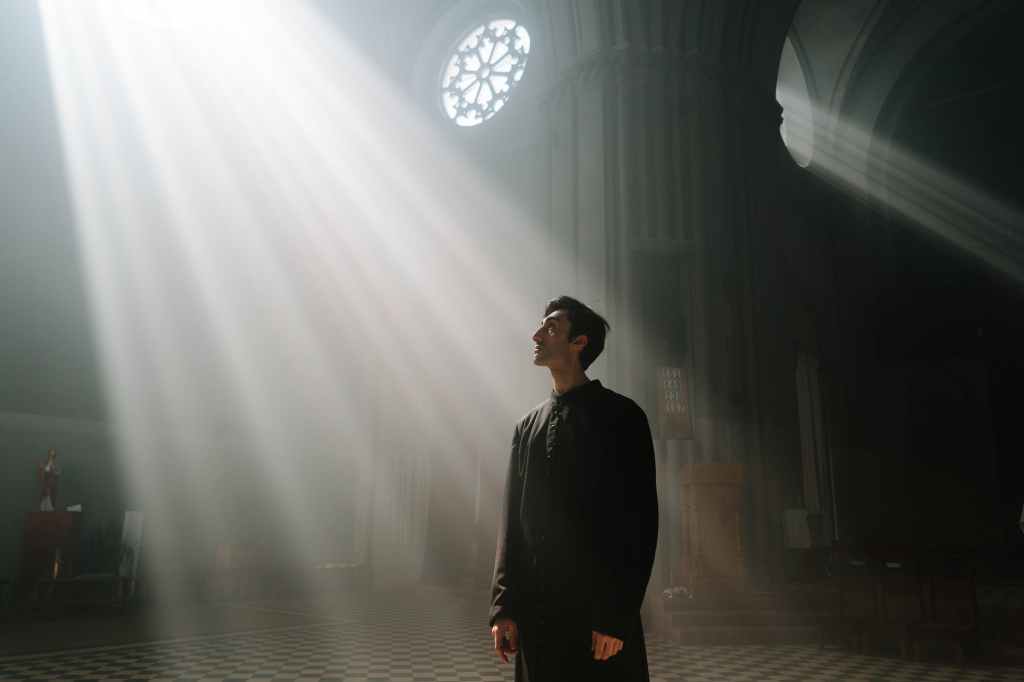
Ever since the establishment of the Roman Catholic Church, and later Protestantism, Westerners have looked to their church leaders to guide them in all matters of life, from who to marry and when to do so, to dealing with neighbor conflicts, to confessing their so-called sins, and everything in between. Priests, pastors, reverends, and ministers still serve this purpose to their congregations, but as religious involvement has dropped over the years, people have looked to other sources for life guidance.
One of the most important times a person would seek out religious guidance was during a troubled time in their life. Perhaps there was a distressing situation happening they needed advice for, something for which we would seek out a therapist today. Other times they may have been suffering from mental distress unconnected to anything in their lives, what we would refer to today as a mental health issue. For this, we often turn to psychiatrists.
As opposed to a psychologist, counselor, or therapist, which is an individual who has received a certain level of education on the inner workings of the human mind, a psychiatrist is a medical practitioner, either a doctor or a nurse, that views mental health from a physical standpoint. They’re concerned not with the psychological workings of the mind, but with the underlying physical processes that potentially drive those workings.
This would be all well and good if there weren’t such a large portion of psychiatrists who believe that all of our inner workings are dictated by electrochemistry alone and nothing else. Who believe all of our thoughts, feelings, and behaviors are merely the manifestations of electrochemical clockwork, and that if they just tinker with this clockwork enough, they can make us happy. Speaking from experience, this could not be further from the truth.
Regrettably, the goal of psychiatry collectively does not seem to be establishing the happiness of their patients, but of the people around them. Questionnaires regarding mental health problems often couch their questions in terms of how other people are affected by the person’s behavior, and may include few questions about how the person themselves feel. Those with mental health issues are often not seen through an individual compassionate lens, but one of collective annoyance, particularly those with more severe issues.
This is understandable from a certain point of view. It is natural for all humans to fear what they do not understand, and if there is one thing that humanity does not yet understand, it is mental illness. As I write, there is an ongoing battle between Western psychiatry which seeks to pathologize anything Western culture does not deem “acceptable” and prescribe a pill for it, and a newly informed wave of therapists, psychologists, and even doctors who recognize that this is not the way to treat what has become a quickly growing mental healthcare crisis in the West.
The problem lies within Western psychiatry’s philosophical viewpoint of mental illness, which is right there in the term “illness”. Anything that does not conform to society’s standards of “normal” becomes an “illness” that needs to be treated. Less than a hundred years ago, this resulted in many women being committed by their husbands to psychiatric institutions under horrifying conditions, merely for being outspoken. As recently as the 1970s, a homosexual person was medically considered a psychological deviant requiring treatment. Our society still deals with the aftereffects of this attitude in the form of adolescent conversion camps which claim to be able to “pray away the gay”.
And yet, this troubling trend of pathologizing anything outside the norm has grown over the years to include religion and spirituality, specifically non-Christian religion and spirituality, resulting in widespread ethnic and sexual discrimination in addition to religious discrimination. Entire spiritual belief systems that are sacred to Indigenous groups all over the world are technically classified as symptoms of our most severe mental disorders: bipolar disorder, schizoaffective disorder, and schizophrenia. A Native American proclaiming to hear the Voice of the Forest would immediately have their sanity questioned.
As I mentioned, this discrimination extends to women, who comprise a large portion of the growing movement of Earth-centered spirituality, which shares a great deal in common with Indigenous forms of spirituality. A woman proclaiming to have a personal relationship with the Goddess is also going to immediately have their sanity questioned.
Spiritual pathologizing is particularly problematic for those of us who had mental episodes that had an undeniable spiritual component to them, those who refer to themselves as having had a “spiritual awakening”. Saying these words to a psychiatrist is a one-way ticket to having something akin to “bipolar disorder” permanently etched into your medical record, because spiritual thinking has been pathologized by Western psychiatry. Telling them that you’re aware you have a mental issue but that you also cannot deny the spiritual aspect of your experience just confuses them. To them, you are either religiously normal by our society’s standards (read: Christian), or you are ill.
I suppose this is also understandable. According to both Catholicism and Protestantism, a normal human being cannot have a personal relationship with the Divine. They require an intermediary in the form of a priest, minister, or other religious authority. A person who has had a spiritual awakening has had a direct, personal experience with whatever constitutes Divinity for them, with nothing and no one between them and It. Culturally and socially speaking, for a person to claim that they have had a direct experience with the Divine sounds heretical, in addition to “insane”.
Another part of the problem is that religion in general, and Christianity specifically, has done so much damage to humanity over the centuries that anyone who holds very deep spiritual beliefs is viewed with suspicion and fear, as though they may be dangerous in some way. This is due to a misperception on the part of humanity as a whole, which has a very loose grasp on the difference between religion and spirituality. Religion has become a collective force created to control large groups of people. Spirituality is an individual phenomenon in which a person forges a personal relationship with whatever the Divine is for them. Even an atheist can have a “spiritual” experience if they have an awakening that leads them to realize the energetic unity of the Universe, which is all Divinity really is.
Again, that leads back to our collective conditioning over the centuries that in order to speak with the Divine, someone must be there to translate for us. Once upon a time, a person making such a claim would be condemned by the Church and perhaps even had an exorcism performed upon them under the premise they were possessed by demons or the Devil himself. Now we send them to a psychiatrist who prescribes them drugs that deaden their mind and soul so they won’t be so disturbing to the people around them.
I do not mean to imply that there are not people in the world who are very clearly ill despite their spiritual inclinations. Sometimes the mentally ill become a danger to themselves or others, although these incidents are incredibly rare and only have public attention because the media has hyped them up. Nor do I mean to imply that there are not people who benefit greatly from a good psychiatrist and the right medication. Yet there are severe dangers to having psychiatrists make spiritual judgments of any kind when it comes to judging the stability of their patients. An Earth-centered spiritualist who has had a spiritual awakening is of far less of a danger to society than an Evangelical Christian with a basement full of guns who thinks they’re on a mission from God.
And yet one receives a stigmatizing label, while the other does not. This is deeply troubling in these sociopolitical times when Christofascism has once again reared its ugly head and unchecked capitalism allows climate change to rapidly approach runaway stage. How can change occur when the new priests of American thought and behavior tell us that to feel at one with the Earth, the Universe, and with each other and to want to fight to preserve them are hallmarks of an illness, while Christian-driven violence goes ignored?
Psychiatry claims to be the keeper of happiness when it is really a barbarian standing at the gate of human progress. Instead of fighting for a better world that doesn’t cause so much trauma and ensuing mental illness, it continues to argue its biopsychosocial theories that rely solely upon the diagnosing of stigmatizing conditions requiring the prescribing of expensive and often debilitating medications that sometimes do little to help the person in question. They merely make us numb to our pain and more compliant to society while making billions upon billions of dollars off of our suffering. It’s more profitable and acceptable to society to give us pills than it is to actually help us.
Correcting this issue will require nothing short of a collective reckoning on the part of all of Western culture, particularly America, regarding the traumatizing ways in which we treat one another, particularly our children. This will be extraordinarily difficult for some people since so many of those traumatizing ways are deeply rooted in the Puritan Christian ethics that have haunted our country since its colonial founding. Separation of church and state may prevent us from being a Christian nation, but we are certainly a Christian culture whether we like it or not.
And being Christian or even exposed to Christianity means being steeped in judgment, day in and day out, 24/7/365. These Christian judgments have necessarily crept into the medical standards that psychiatrists use today to judge our mental stability and worthiness. After all, for a long time, psychiatrists were nothing but white Christian men, a trend that continues today. The mass revealing going on today of white Christian patriarchy’s various crimes over the centuries means that psychiatry itself is undergoing scrutiny, at last. The pathologizing paradigm has been so unsuccessful that the National Institutes of Health has stepped away from it towards what it calls a “dimensional approach” that doesn’t label people and just treats their symptoms. In the process, new paths have been made for the latest trauma research, which opposes or outright negates the decades-old assertion of Western psychiatry that our mental processes are merely the product of electrochemical clockwork gone awry while giving short shrift to our psychological and social environments.
For myself, I have found the greatest healing by ignoring much of what psychiatrists tell me (though I still take my meds), adhering to somatic-based therapeutic methods to deal with my trauma load, keeping my spiritual life to myself unless I know I’m in “safe company”, and cultivating that spiritual life, because it has been the greatest gift ever given to me. While receiving this gift resulted in a psychospiritual episode that appeared “manic” to those around me, the inner reality is that I was far sicker before the episode than I was afterwards, and the spiritual gifts that I received are what have enabled me to heal myself from the damage done to me by others, including psychiatrists.
I realize that gives me a far different perspective on life and the world than most people have, but that does not mean that difference should be pathologized. If we are to have an inclusive world that accommodates each of us for both our strengths and our weaknesses, we will have to stop pathologizing those who possess beliefs different than those of the prevailing culture. This is ever more important in the era of increasing climate change when the focus needs to be on our ecology and the environment, which will necessarily include no longer excluding spiritual belief systems that are experientially focused and Earth-centered for being “crazy”.
Psychiatry has done what all humans do with something they don’t understand but cannot deny: they fear it and label it as insane, particularly if it contradicts their own worldviews. Most psychiatrists will be completely unable or unwilling to entertain someone’s tale of profound spiritual awakening and take them seriously. Even outside the extreme phenomenon of spiritual awakenings, a psychiatrist is unlikely to take seriously any non-Christian spiritual life, particularly one that contains what would be considered to be Indigenous or “pagan” elements. If we are to both honor mental health awareness and create a survivable world, psychiatrists will have to be removed from their position of the new priesthood.






 The Bipolar Bodhisattva
Leave a reply to Rainy K. Cancel reply