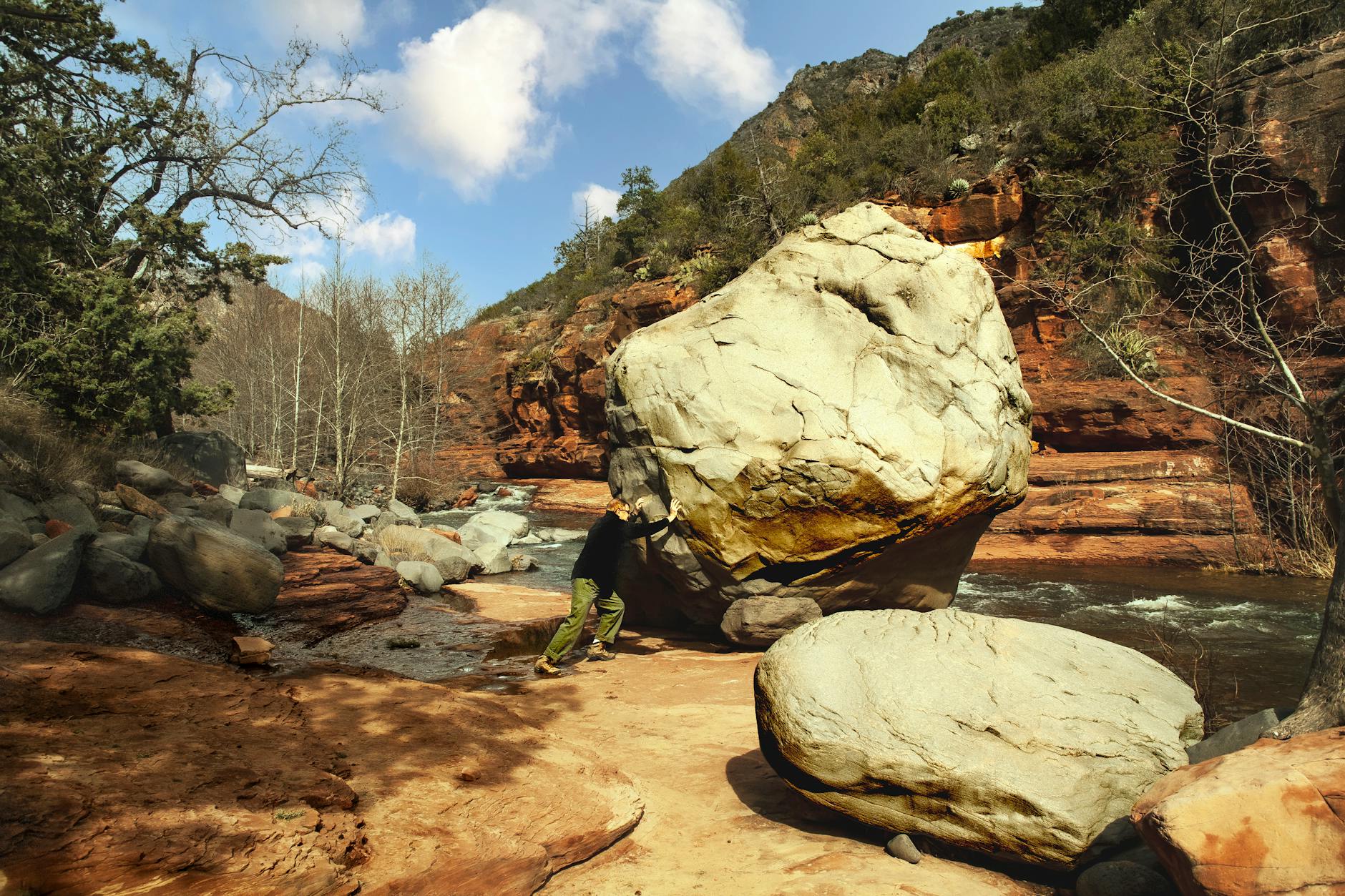
In the Greek myth of Sisyphus, the king of Ephyra was punished by Zeus for the crime of violating guest hospitality by killing visitors, as well as cheating Death (twice). In retaliation for these crimes, he was condemned to an eternity of rolling a boulder up a hill only to have it roll back down to the bottom just as he reached the top. The meaning of this myth has been translated in various ways over the centuries, but its most prominent meaning is that of representing difficult, pointless, and repetitive tasks that feel like punishment.
There are many ways that modern life feels Sisyphean in nature. Our lives are filled with tasks that must be repeated over and over again just as a matter of the necessities of life. Dishes, laundry, vacuuming and sweeping, mopping, going to work, cooking and eating, the list is seemingly endless. And sometimes it all seems so pointless. “What am I doing this for?” we ask ourselves. Day in, day out, the same shit over and over again.
If our lives are devoid of anything meaningful that make us feel fulfilled, then we will see daily life as being filled with an endless sequence of Sisyphean tasks, one after another. A life like this can quickly become one filled with despair. If at all possible, it is critical to insert some meaningful activity in amongst the boulders one must constantly roll uphill, or one is at risk of saying “fuck it” and just letting all the boulders roll back and stay there.
I’ve had this happen to me, and it’s not fun. You become filled with guilt at the sight of all of the boulders in your life just sitting there, unmoved, because you just can’t bring yourself to push them anymore. What’s the point? They bring nothing to your life, so why bother? It can’t be fulfilling enough for most of us just to have a clean house, clean clothes, and food in the fridge. That may satisfy our physical needs, but does little to satisfy our spirits and souls.
I’m currently struggling with the boulders in my life. I’ve allowed a few to fall back because I just don’t have the spoons to care anymore. I’m focusing on filling my life with fulfilling activities that are smaller, more achievable labors. At the same time, I’m trying to cultivate the “peace is every step” mindset of the late Zen Buddhist Thich Nhat Hanh. He wrote a book by the same title that talks about how to find peace in every moment of life, even during the Sisyphean tasks (perhaps especially those tasks).
This involves “being in the moment” and not thinking about the past or future, which is difficult if you’re in the middle of a task you don’t want to be doing. We tend to go through such tasks mindlessly in an effort to avoid the discomfort that comes with them, choosing instead to dwell in a past memory or a future fantasy to distract ourselves as we complete the task as quickly as possible. Thay (“teacher”), as Thich Nhat Hanh’s students called him, said that dwelling in the present moment during unpleasant tasks can open oneself to peacefulness and insight that is otherwise closed off if we are elsewhere in our minds. He encouraged finding a potentially pleasant aspect of the task to focus on instead. For instance, if you hate washing dishes but there’s a kitchen window over your sink, try paying attention to the way the sunlight plays in the water, or the warmth on your hands. There’s also the act of focusing on how nice it is to have all the dishes clean.
For me, the hated task has become cooking after more than 20 or more years of being the person mostly responsible for doing it. Being responsible for meals is more than just cooking the food. I have to plan ahead so I can shop unless I want to go to the store every day. I have to make sure food gets taken out of the freezer on time if we’re going to eat at a reasonable time. Sometimes I have to find a new recipe if I’m trying to break us out of a boring rut, which is important if we don’t want to fall into a habit of eating out, as we are prone to doing.
Then there’s the actual cooking of the food, and my mental health means that I may not be up for putting a lot of energy into that on any given night. That means keeping quick foods around that take little to no effort, which again, requires planning and shopping ahead. If I’m in the mood, I enjoy cooking a new recipe or even a somewhat time-consuming old one. If I’ve been busy that day, though, or my headspace isn’t right, then I can’t make the mental shift into cooking mode.
This is the Sisyphean boulder that winds up laying at the bottom of the hill most often. It sits next to the one labeled “exercise”, which gets harder and harder to push up the hill the older I get. I keep staring at it with guilt, knowing I really need to start pushing that sucker up the hill even though I know it won’t get far and will roll back down.
This has been represented in real life by an actual hill behind our old house that was about a 600’ climb from the front door, and presently by another shorter but steeper hill that we live at the base of. My husband had made it to the top of the previous hill, but I barely made it to the tree line. I’ve had this vision of walking as far up the hill as I can every day in the hope that I’ll climb a little bit higher every day or week, until eventually I reach the top. This will make me ready for other hikes in this beautiful state I live in.
Thich Nhat Hanh would say this is an excellent way to add meaning to an otherwise seemingly fruitless task. It requires faith in the results, though. Exercise is something with which the results cannot be seen or felt for a considerable amount of time, typically weeks. The only way to persist with the activity until progress is seen or felt is by trusting that it’s worth it and envisioning the eventual reward.
The reward in this case would be the ability to visit many beautiful parts of my new home state that I am currently too weak to go to. There is nothing wrong with me preventing me from building my strength. I am merely middle-aged now, which means it will take a lot longer to get in shape than it would have 20 or 30 years ago. It can be done, though. I would love to be one of those fit older people that puts the youngsters to shame.
The only barrier to pushing the boulder up the hill, to pushing myself up the hill, is psychological. I have to think it’s worth the effort to engage in pushing the boulder, and at present, there’s a large part of me that doesn’t think it’s worth it. It’s tired after a life of trauma, and sometimes it’s done with living entirely. Those are not good days.
That is the ultimate Sisyphean task: just getting up and living life every day. If the daily task of rolling the boulder up the hill is represented by fulfilling activities, then it doesn’t feel like a punishment, and one doesn’t mind letting it roll back down the hill at the end of the day. But if one is leading a life absent of fulfilling activities and is in fact leading one filled with unfulfilling activities, then the daily act of rolling the boulder up the hill becomes unbearable. These are the people who find themselves crying in the parking lot at work in the morning sometimes because they don’t work to live, they live to work and feed the Capitalist Machine instead of themselves.
The daily act of rolling the boulder up the hill is problematic for me because I so often despair at the state of my country and the world. There’s so much in the world that hurts me and makes me bleed, it’s no wonder that I mostly keep to myself and have closed myself off to most input from the outside world. It’s just too painful. I worry constantly about what the world is going to look like when I’m older and how my husband and I are going to be taken care of in a world where we’ve been able to save nothing for retirement because the Powers-That-Be have essentially stolen all of our money away. Meanwhile, the future has also been stolen from our children before they could even get their hands on it, which means we can’t count on them to take care of us, either.
All of these things make it difficult to roll the boulders of life up their respective hills, and it seems like we are all engaged in a constant game of rolling one boulder up only to have to let it go so we can run and push on another one. It really does feel like punishment, and in a way, it is. The Powers-That-Be are a very exclusive club that has deemed the vast majority of humanity unworthy of anything. If we are suffering, then in their eyes, we deserve it, and so they are perfectly happy to keep us in a world where all we do is push meaningless boulders that generate cash for those same Powers.
However, I know that what they want is for us to give up on pushing our personal, more fulfilling boulders and only focus on the ones that we’ve been chained to. The boulders with chains support the Powers-That-Be: the personal ones do not. In fact, the personal boulders of meaning and fulfillment fight directly against the ones laden with despair. They are lighter and easier to push, but strangely fill people with far greater strength. This is why our lives have been engineered to take as much time as possible away from pushing personal boulders. People with meaning-filled lives are much more likely to fight back, and they don’t want that.
There is another important element that can help with Sisyphean tasks, and that’s acceptance, although this can be a very difficult concept to grapple with. It can often be abused by those in power who deliberately cause suffering and tell the rest of us we just have to accept it. Enforced futility and oppression should never be accepted. Nevertheless, our lives are filled with inevitabilities, such as the dishes and the laundry, that it is best to try to fully accept and incorporate into our lives. We should make adaptations as necessary so that these tasks are not so onerous, but it’s folly to be constantly angry about something benign that must be done, like laundry.
This is when “peace is every step” is the most useful, with the everyday tasks that all of us must tend to. There is indeed a peace that comes with being able to be fully in the moment of whatever you are doing. It’s a state of mind that drops down deeply into a place of stillness beyond the judgments that make you hate what you’re doing. Operating beyond judgment allows you to push the boulder to a height of “good enough” rather than all the way to the unachievably “perfect” top.
Can you wash and dry the clothes but not fold them? Then leave them in a basket to root through in the morning and just keep the dirty separate from the clean, or put them in the dresser unfolded so it’s easier to find things. Can you wash the dishes but not put them away? Fine, leave them in the drainer or the dishwasher to be used as needed, make a space for dirty dishes, and designate a day or two of the week when you rotate everything out. Do you have an hour a day to exercise but despise going to the gym (like me)? Do anything active during that time, even if it’s just a walk out in nature or around a park. Some movement is better than none. Do you want to eat healthier but don’t have time to cook? Buy some frozen meals from a health food store, they’ve improved greatly over the years.
Our modern lives are full of boulders to push up hills, but we don’t have to be crushed by them. We can even choose which ones to push sometimes, and we can choose how to push our boulders. We can also adjust our perspectives so that pushing inevitable boulders doesn’t feel like a punishment, though that can often involve adding a personal boulder that gives us hope. Repeating tasks need not always represent futility and meaninglessness. With the right outlook, we can make room for fulfillment and find meaning in the repetitive tasks of life.



Leave a Reply